05InvestorsLock-up and dividends
Paid to the patient.
Tokens earn in the vault; only full periods are paid.
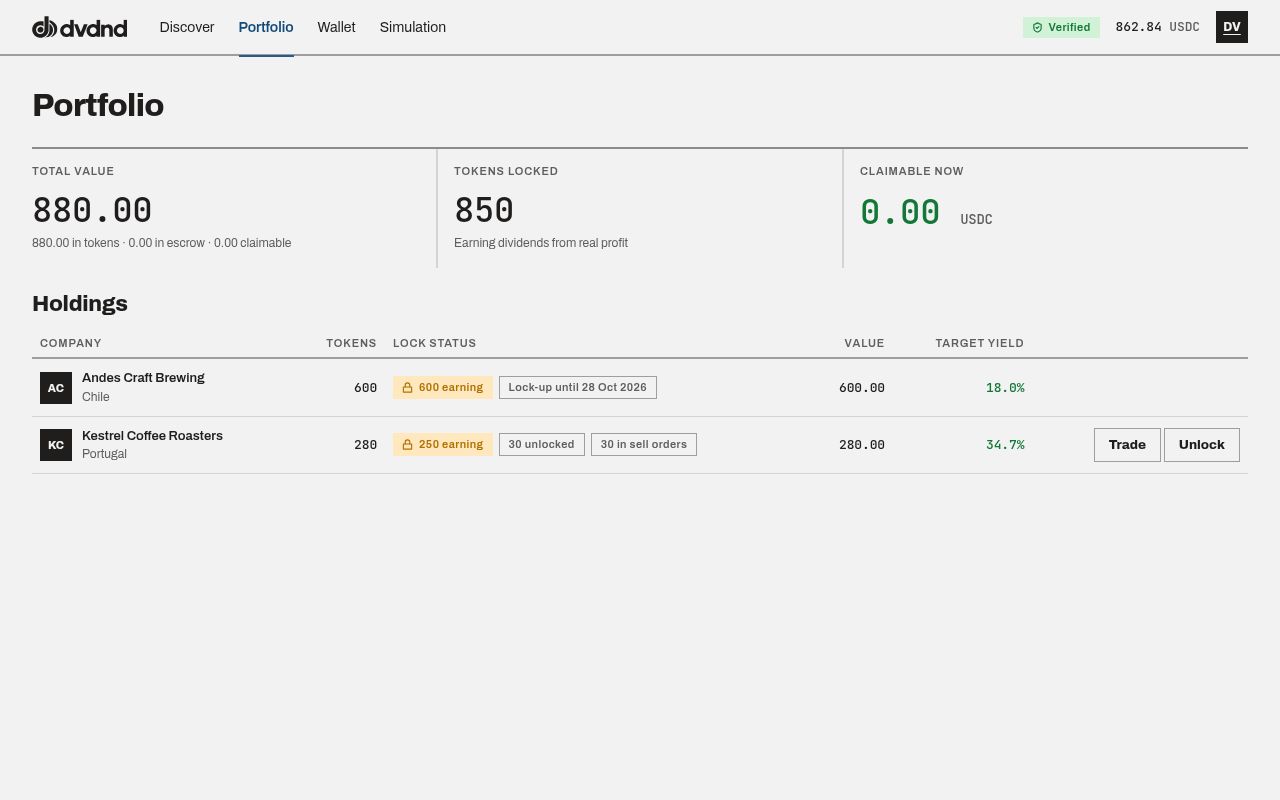
Dividends reward holders who stay. A company commits a share of its yearly net profit and pays it in USDC each period. The payout is split pro-rata among tokens that were locked in the vault for the whole period, so locking just before a payout earns nothing.
1. Lock
Tokens bought during a lock-up are already in the vault. Afterwards, holders choose how much to lock. Tokens locked now start earning from the next period, and can be unlocked at any time.
Recorded on Stellar testnet
2. The company pays
At the end of a period the company enters its net profit; the page works out the committed share and pays it to the vault in one transaction, which also starts the next period.
Recorded on Stellar testnet
3. Holders claim
Recorded on Stellar testnet
On-chain
- The
vaultkeeps a reward-per-token accumulator per share token, plus active and pending totals. lockadds pending tokens.distributepays the period and turns pending into active.claimpays out what each holder is owed.- Every call costs the same however many holders there are. There is no loop over holders.
Legal
- The obligation to pay is in the signed profit-share agreement, enforced off-chain. The chain records every payment.
- Late payments are flagged on the listing.
- Tokens in a lock-up can't move because the wallet's trustline is deauthorized. They still earn.